Friday, October 17, 2014
Construct graphene into porous three-dimensional structures
Kyoto, Japan -- Researchers in Japan have developed a novel yet simple technique, called "diffusion driven layer-by-layer assembly," to construct graphene into porous three-dimensional (3D) structures for applications in devices such as batteries and supercapacitors. Their study was recently published in the journal Nature Communications.
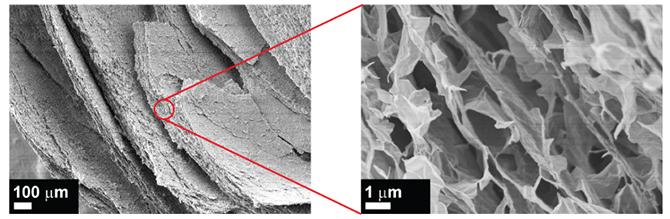
The resulting products display a foam-like porous structure, ideal for maximizing the benefits of graphene, with the porosity tunable from ultra-light to highly dense through simple changes in experimental conditions. Furthermore, the process is easily scalable for creating large-area films which will be highly useful as electrodes and membranes for energy generation or storage.
"While we have only demonstrated the construction of graphene-based structures in this study, we strongly believe that the new technique will be able to serve as a general method for the assembly of a much wider range of nanomaterials," concluded Franklin Kim, the principal investigator of the study.
Source: http://www.icems.kyoto-u.ac.jp/e/pr/2014/10/16-nr.html
Monday, October 13, 2014
The resulting products display a foam-like porous structure, ideal for maximizing the benefits of graphene, with the porosity tunable from ultra-light to highly dense through simple changes in experimental conditions. Furthermore, the process is easily scalable for creating large-area films which will be highly useful as electrodes and membranes for energy generation or storage.
"While we have only demonstrated the construction of graphene-based structures in this study, we strongly believe that the new technique will be able to serve as a general method for the assembly of a much wider range of nanomaterials," concluded Franklin Kim, the principal investigator of the study.
Source: http://www.icems.kyoto-u.ac.jp/e/pr/2014/10/16-nr.html


Graphene enable Italy's Vittoria to launch the world's fastest bicycle wheels
International wheel producer Vittoria released a new range of bicycle race wheels that are built from graphene-enhanced composite materials. The new wheels (called Qurano) are the best wheels offered by Vittoria, and they say these are the fastest wheels in the world - all thanks to graphene.

The company explains that adding graphene to their carbon-fiber matrix built wheel rim improved the material properties by 10-30%. The graphene reduces temperature build-up, it increases spoke-hole strength and improves the lateral stiffness. Vittoria tells us that even though the Qurano wheels outperform their previous carbon-fiber wheels, they are priced the same.
Source: http://www.graphene-info.com/italys-vittoria-launches-graphene-enhanced-bicycle-wheels
Ultra-thin diamond nanothreads
UNIVERSITY PARK, Pa. -- For the first time, scientists have discovered how to produce ultra-thin "diamond nanothreads" that promise extraordinary properties, including strength and stiffness greater than that of today's strongest nanotubes and polymers. A paper describing this discovery by a research team led by John V. Badding, a professor of chemistry at Penn State, was published in the Sept. 21 issue of the journal Nature Materials.
Scaling graphene production for commercial applications
An official of a materials technology and manufacturing startup based on a Purdue University innovation says his company is addressing the challenge of scaling graphene production for commercial applications.
Read more
Wednesday, August 28, 2013
Read more
Carbon-Based Nano-Materials and Devices
An ECI Conference
November 3-8, 2013
Promised Land Resort & Lagoon, Hualien, Taiwan
Promised Land Resort & Lagoon, Hualien, Taiwan
This conference aims to provide a forum for researchers, scientists and engineers from different countries worldwide, who are actively involved in the research on nanoscience and nanotechnology, in particular on carbon-based nanomaterials and their device applications such as biological and chemical sensing, energy conversion and harvesting, electronic and photonic applications, catalysis, electrochemistry, and simulations, to disseminate their latest research results and development achievements. In addition to the exciting scientific and technological themes, the conference offers a platform to promote and encourage interaction among researchers for cross-fertilization of ideas and collaboration. The program will consist of a series of invited, contributed oral, and poster presentations. To enhance the interaction with poster presenters, they will also give a short introduction (3 min) to advertise their work. In addition, a panel discussion will be held to promote the interaction among scientists and researchers, including discussions on new research directions for carbon-based nano-materials and devices, summary of the current state of the art and future barriers, and projections of future frontiers.
Topics:
- Synthesis of carbon-based nanomaterials: carbon nanoparticles, carbon nanotubes, graphene, nanodiamonds, carbon-based thin films and molecules, etc.
- Characterization and processing of carbon-based nanomaterials: surface and interface modification, functionalization, assembly and patterning, etc.
- Devices and Applications of carbon-based nanomaterials: biological and chemical sensing, energy conversion and harvesting, electronic and photonic applications, catalysis, electrochemistry etc.
- Multiscale modeling and computation in the above areas.
Future looks bright for carbon nanotube solar cells
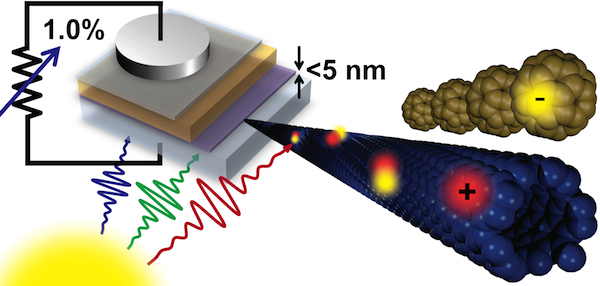
Light from the sun creates charges in an ultrathinfilm of carbon nanotubes (blue), which are extracted by fullerene C60 (brown) in this schematic of the groundbreaking proof-of-concept solar cell with greater than 1 percent efficiency.
In an approach that could challenge silicon as the predominant photovoltaic cell material, University of Wisconsin-Madison materials engineers have developed an inexpensive solar cell that exploits carbon nanotubes to absorb and convert energy from the sun.
Graphene 2014
Toulouse (France) will host the 4th edition of Graphene Conference series, the largest European Event in Graphene, from the 6th until the 9th of May 2014 at Centre de Congres Pierre Baudis.
A Plenary session with internationally renowned speakers, extensive thematic workshops in parallel, an important industrial exhibition carried out with the latest Graphene nanotrends for the future and a brokerage event will be some of the features of this event.
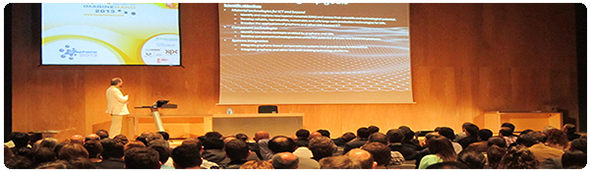
Following the overwhelming success of the last three editions of Graphene, Phantoms Foundation is pleased to announce the fourth edition of this great event that will gather the Graphene community, including researchers, industry policymakers, investors and plans to be a reference in Europe in the upcoming years.
For more information visit: www.grapheneconf.com
A Plenary session with internationally renowned speakers, extensive thematic workshops in parallel, an important industrial exhibition carried out with the latest Graphene nanotrends for the future and a brokerage event will be some of the features of this event.
Following the overwhelming success of the last three editions of Graphene, Phantoms Foundation is pleased to announce the fourth edition of this great event that will gather the Graphene community, including researchers, industry policymakers, investors and plans to be a reference in Europe in the upcoming years.
For more information visit: www.grapheneconf.com

Subscribe to Posts [Atom]


